You're reading the documentation for a development version. For the latest stable documentation, please have a look at v5.1.X.







CADET-Core
CADET is developed at the Institute of Bio- and Geosciences 1 (IBG-1) of Forschungszentrum Jülich (FZJ) under supervision of Prof. Eric von Lieres. The heart of the CADET software is CADET-Core, a fast and accurate solver for a comprehensive model family. Typical applications include (but are by far not limited to) chromatography, filtration, crystallization, and fermentation. CADET-Core can handle arbitrary sequences and networks of unit operations, including reactors, tanks, tubes, pumps, valves, detectors, etc. The resulting models are solved with state-of-the-art mathematical algorithms and scientific computing techniques.
Forum: https://forum.cadet-web.de
To stay up to date on CADET news, development updates, and workshops, please subscribe to our Newsletter.
Features
Fast and accurate solution of strongly coupled partial differential algebraic equations (PDAE)
Computation of parameter sensitivities with algorithmic differentiation (AD)
Shared memory parallelization using Intel TBB
Python interface
Support of HDF5 and XML data formats
Flexible and extensible through modular design
Works on Windows, Linux, and Mac OS X
CADET Platform
CADET-Core is part of CADET, a collective platform of software repositories that provide tools for biotechnology process modeling. CADET-Core can be used as a standalone simulator by interfacing via HDF5 files. Alternatively, CADET-Python provides a wrapper around an HDF5 file reader and writer, simplifying model configuration. Furthermore, it is the interface for CADET-Process, an universal and user-friendly tool for biotechnology process modeling and evaluation.
For more information on the different packages of the CADET platform, see here.
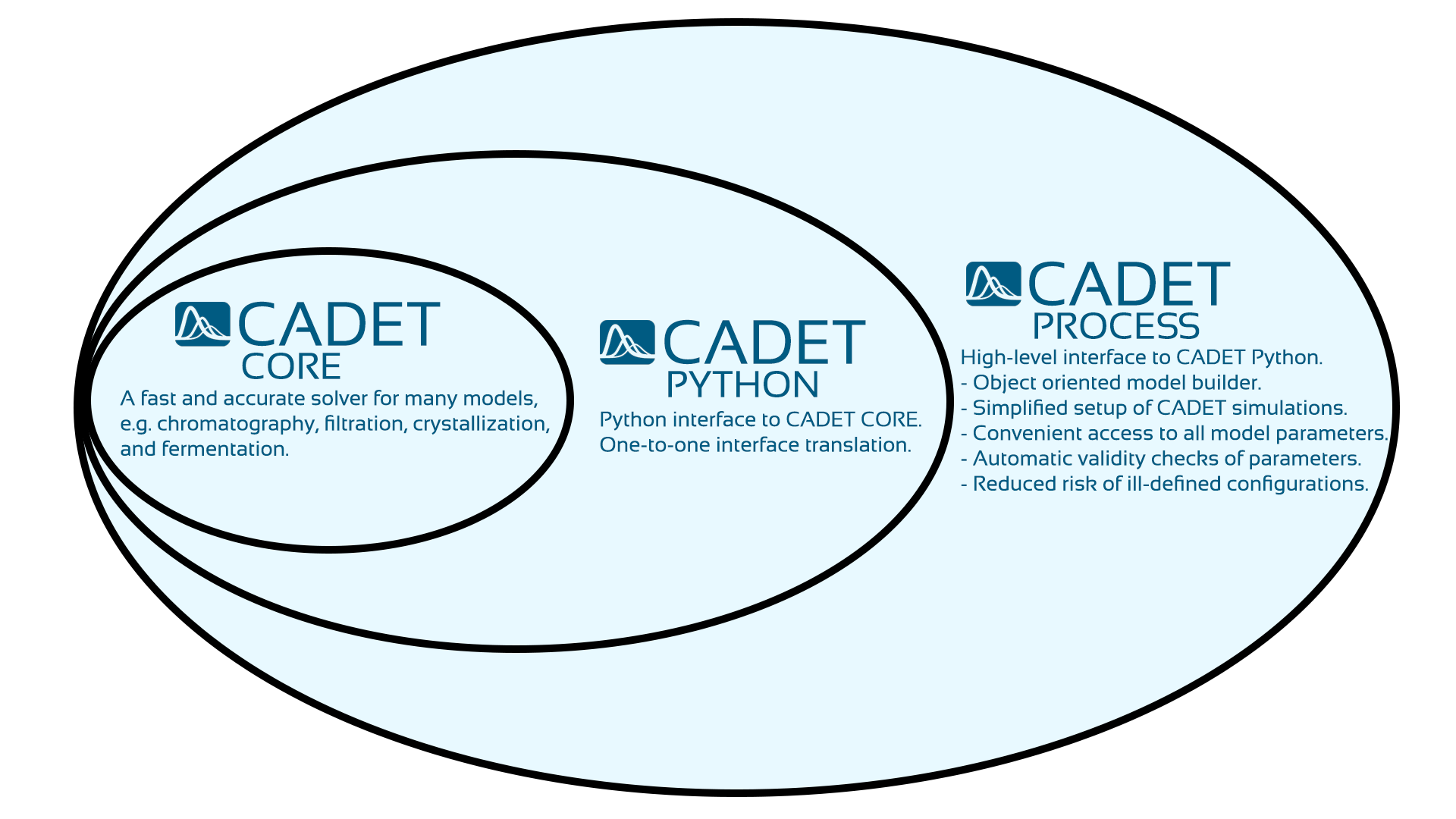
Fig. 1 Relations between CADET-Core, CADET-Python, and CADET-Process.
Installation
CADET-Core can be installed via conda from the conda-forge channel.
conda install -c conda-forge cadet
This requires a working conda installation.
Optionally, use mamba which uses a faster dependency solver than conda.
mamba install -c conda-forge cadet
For more information on how to install and build CADET, see here.
Ongoing Development
We do our best to provide you with a stable API. However, CADET-Core is actively developed and breaking changes can sometimes be unavoidable. For non-developers, it is recommended to upgrade from release to release instead of always working with the most recent commit.
Bugs
Please report any bugs that you find here. Or, even better, fork the repository on GitHub and create a pull request (PR) with the fix.
Donations
Donations for helping to host, maintain, and further develop the CADET-Core project are highly appreciated.
Citing
As an open-source project, CADET-Core relies on the support and recognition from users and researchers to thrive. Therefore, we kindly ask that any publications or projects leveraging the capabilities of CADET-Core acknowledge its creators and their contributions by citing an adequate selection of our publications.
General:
Breuer, J. M.; Leweke, S.; Schmölder, J.; Berger, A.; Gassner, G. J.; von Lieres, E.: A unified and composable framework for modeling packed-bed liquid chromatography, arXiv preprint arXiv:2610.33269 (2026).
Leweke, S.; Breuer, J.; Schmölder, J.; Jäpel, R.; Lanzrath, H.; Rao, J.; Hassan, J.; Zhang, W.; Berger, A.; Heymann, W.; von Lieres, E.: CADET-Core 5.0: High-Performance Solver for Advanced Biotechnology Process Modeling, Journal of Open Source Software 10 (2025), 7881.
Leweke, S.; von Lieres, E.: Chromatography Analysis and Design Toolkit (CADET), Computers and Chemical Engineering 113 (2018), 274–294.
Additionally, to ensure reproducibility of your work, we recommend citing the zenodo doi corresponding to the specific CADET-Core release that you used.
Beyond these general references, major extensions have enabled specific features of CADET-Core, such as the DG discretization, the crystallization models, or the parameter sensitivities. If your work makes use of such a feature, please cite the corresponding publication as well. For a comprehensive list of our publications and guidance on citing them, please refer to the Publications section of this documentation.
Acknowledgments
Please refer to the list of authors and contributors who helped building and funding this project.